Search This Blog

Thursday, April 4, 2013

Necessity breeds innovation: Shooting the wait times video series at “The Taming of the Queue 2013”

Waiting can be tough but it’s a fact of life and something we all deal with. It is one thing to wait in line at the coffee shop or for the new iPhone release, and quite another to wait for health care. Waiting to see your family physician for a checkup; waiting to be seen in the emergency room; or being on a wait list for surgery, are all things Canadians experience daily.

In Canada, longer than normal wait times pervade our health care system and physicians, policy makers and other health experts agree that we need to take action.

That’s what some leading organizations and provinces are doing. Starting in late spring, the Health Council will be releasing a video series on wait times in Canada.

In preparation for this series, I was in Ottawa late last month to shoot footage of the Taming of the Queue conference. My colleague, Media Specialist Terry Glecoff and I were on hand to gather interviews from conference participants. We captured a variety of insights on the issue and responses to the complex question: why do we wait?

Dr. Tom Noseworthy of Alberta Health Services responds to questions posed by Media Specialist Terry Glecoff


One of our subjects, Dr. Tom Noseworthy, Associate Chief Medical Officer, Strategic Clinical Networks & Clinical Care Pathways for Alberta Health Services, put it as such:

“In a universal health care system where everybody is included, they are usually challenged by access – getting people in – when people are not all included it’s easier to achieve access. But we have long wait times in Canada, and we need to retool the system to make it better. So we’ve got it right on the inclusion side with universality. We don’t have it right on waiting times.”
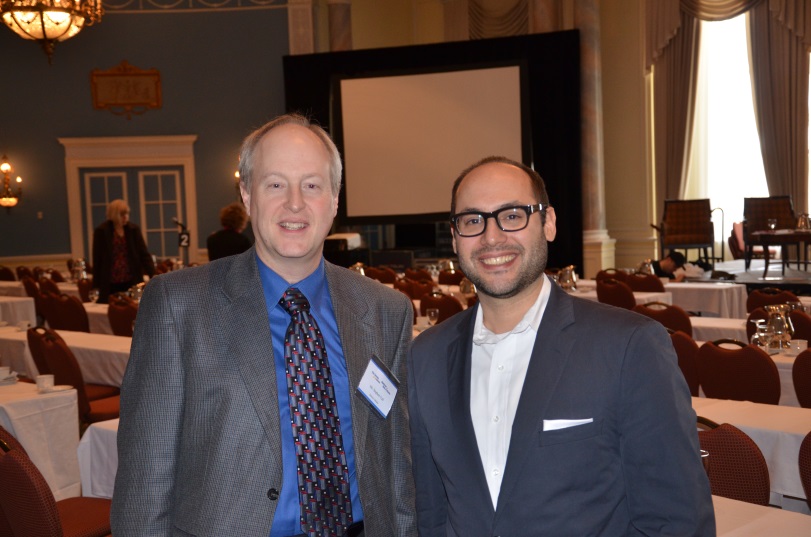
The Canadian Medical Association's Stephen Vail with Ari Grief, Project Lead for our upcoming wait times video series

In addition to shooting footage, I had the opportunity to talk to health leaders about their views on wait times. My main takeaway from the conference is that there are numerous innovative practices working to reduce wait times around Canada in a variety of settings – it’s just a matter of spreading the word to other jurisdictions across the country. 

Along with Dr. Noseworthy’s interview, we captured a range of different perspectives on wait times. These insights will be revealed together with innovative practices that are working to reduce wait times in our upcoming video series.

Stay tuned.

By Ari Grief, Bilingual Communications Specialist/Project Lead Wait Times in Canada Video series.

Tuesday, April 2, 2013

Health Council reveals winners of fourth annual Health Innovation Challenge

Today we announced the winners of the fourth annual Health Innovation Challenge. In September, we challenged college and university students to find innovative practices in Canadian health care, tell us why the innovations are working, and how they can be applied in the rest of the country.

Over 100 students across Canada participated, submitting a total of 74 essays explaining which innovative practices they think could change the future of health care in Canada. From a shortlist of 10, we will be awarding first, second and third in each of the individual and group categories.

Winning entries came from the University of Alberta, Dalhousie University, McMaster University, the University of Northern British Columbia and the University of Toronto.

“The winners of this year’s Challenge truly showed us the importance of sharing innovation” said John G. Abbott, CEO, Health Council of Canada. “They found some great practices that are working locally and we should pay attention to see if we can learn from them and use them in our own work.”

The Health Council of Canada identifies and shares hundreds of innovative practices from across the country on the Health Innovation Portal. Winning Challenge entries will be featured across the Council’s online properties. Winners also receive a cash prize and the chance to apply for a summer internship at the Health Council of Canada office in Toronto, Ontario.


Full Winners List: 


Category: Individual 


First Place 
Mary Qiu
University of Toronto
Preventing Acute Care Hospital Readmissions Through the Use of a Virtual Ward

Second Place Sophia Harrison
University of Northern British Columbia
A New Way Forward: Improving the Health Status of British Columbian First Nations with the Tripartite First Nations Health Plan

Third Place Jake Yorke
Dalhousie University
Collaborative Emergency Centres: Improving Access to Primary and Emergency Care in Rural Nova Scotia

Category: Group


First Place Aaron Lau, Alexandre Tran, Yvonne Tse

McMaster University
The McMaster PIPER Project: A Novel Approach to Interprofessional Education through Simulation-Based Learning

Second Place Haley Augustine & Rakesh Gupta
Dalhousie University
Chronic Disease Management Strategy: Diabetes Quality Collaborative

Third Place Kathryn Reid & Joshua Plante
University of Alberta
Changing Practice Paradigm through Innovative Policy

Tuesday, March 26, 2013

Let's get together

Hugh B. MacLeod is CEO of the Canadian Patient Safety Institute. His interests lie in the areas of system/integrative thinking, sustainability, and organizational cultures that create high performance.

While we may have differences in how we move forward the quality agenda, we have common challenges and with them common opportunities to be leveraged, shaped, and enabled. Now is the time for strong, courageous and committed collaborative leadership from funders, policy makers, direct delivery operations and supporting national and provincial organizations. While good policy direction and alignment of effort are important, the patient voice is a huge system quality and patient safety lever and enabler…a valuable game changer. 


Which way to Quality, challenges us to meet and work together. A common thread throughout the report is a call for an aligned quality agenda that links federal, provincial and local efforts.  A smooth operating system is not the product of a series of isolated actions. We need the orchestration of interactions at the right time, for the right patients, in the right places. The following quote from the report sums up for me where we must go… “all of us can benefit from learning more about each other’s quality improvement efforts, sharing what works, and discussing ways to overcome common challenges. Sharing information and innovation among provinces and territories is absolutely the way to go”.If we collectively want to accelerate change and improve performance on a larger scale as discussed in this report, we have to do things differently. “We” means the actors (many were interviewed for this report) – governments, regulatory agencies, organizations, leaders, etc. All have either legal or moral authority to demand and compel a different path forward.

On the Patient Safety front, CPSI through its new business plan is committed to providing leadership through a consortium of partners to establish a National Integrated Patient Safety Strategy. In keeping with the spirit of this report, CPSI has identified three complimentary goals: knowledge mobilization and innovation; building capability (patient safety knowledge and skills) and expanding reach by engaging audiences across the health system.

Which way to Quality? Let’s answer the question by coming together and working together!